
Finding Chantilly Resident Records
Chantilly has no clerk, assessor, or voter office of its own. Fairfax County and the Commonwealth hold the useful paper. An address, a recorded owner, a historical household, or a court party each sit in a different system, so start from the fact already in hand. An address checks out fastest through county assessment tools. A bare name needs a second anchor, like a former address or a case number. Dated library listings help with family history. They cannot prove a current household, which is where most resident lookup attempts go wrong.
Roles matter more than people expect. A parcel owner may get mail somewhere else entirely. A deed grantee is a party to a recorded transfer, and a directory subscriber is a dated listing from one year. None of those labels means resident, a real problem in Chantilly, where postal city, Census geography, and mailing address can carry different labels.
- Check the county address and parcel record, preserving the exact address, unit if known, parcel identifier, and search date.
- Use the assessment result to distinguish the property location from the owner and mailing fields that appear.
- Match a recorded transfer through the Circuit Court land-record path when ownership history is the question.
- For an earlier household, consult the Fairfax Community Directory and related Virginia Room holdings for the right year.
- When an agency holds a record without an online index, ask that custodian about its own request, counter, library, or archive route.
An empty result is rarely a straight answer. Note: A blank search can reflect a historical address, a missing unit, a restricted record, or a jurisdiction mismatch rather than an answer about the person.
Chantilly Residents Records Desks
Fairfax County supplies the local desks a Chantilly residents directory search leans on. The Department of Tax Administration ties an address to its parcel. GIS tools show address status and parcel geography. Land instruments and the public case index live with the Circuit Court. The Virginia Room keeps the local history shelf. Street-by-street work belongs on the Chantilly street directory. It sets out the address chain in detail.
Fairfax DTA Real Estate
12000 Government Center Parkway, Suite 357
Fairfax, VA 22035
703-222-8234
Circuit Court Land Records
4110 Chain Bridge Road, Suite 317
Fairfax, VA 22030
703-691-7320, press 3 then 3
Fairfax Virginia Room
10360 North Street, second floor
Fairfax, VA 22030-2514
703-293-6227, option 6
The Circuit Court also runs public research terminals and its CPAN service for deeper court and land-record digging. Vital certificates belong to the Virginia Department of Health. No Chantilly office touches them. The Virginia Department of Elections offers a portal for an individual's own status and polling place, though state law controls who may pull voter lists.
Chantilly Starts With Fairfax Geography
Chantilly is a Census Designated Place, not an incorporated Virginia city. It functions as a community label inside Fairfax County. That is why a property, court, library, or planning question usually begins at the county level. The postal address can still read Chantilly. The Circuit Court serves Fairfax County and the City of Fairfax. Alexandria and Falls Church follow their own courts.
Start with the county's Master Address Repository for address, parcel, and street status. iCare supplies the assessment fields. MAR reaches current and historical address records. It skips unit numbers. It also holds no assessment data. A hit there proves an address record exists rather than occupancy or ownership.
- Parcel
- A county identifier for a piece of land, not a street address or a household list.
- Situs address
- The physical property location. It can differ from the owner’s mailing address.
- Index
- A finding tool that points to a record; it is not automatically the document image or a certified copy.
- Criss-cross directory
- A historical directory arranged from address to listed subscriber rather than from name to address.
Search Chantilly Addresses in iCare
Fairfax iCare serves as the county's main assessment lookup. It gives residents three ways in. Search by address, by map number, or through the map itself. A broad address search often beats forcing a suffix. The county's own tip says to leave the suffix off for the best hits. Wildcards work well for discovery, though the county's official spelling should carry into any notes kept alongside the lookup. iCare refreshes twice a week, and real-estate assessments are pegged to January 1 each year.
| iCare control | How it is used | Practical limit |
|---|---|---|
| Number | Enter a street number when known. | It is optional and can be left broad. |
| Unit# | Supply a recognized unit value. | MAR separately omits apartment units. |
| Street | Use the street name; the portal shows wildcard examples. | A result is not a complete street inventory. |
| Suffix | Choose or enter it when it improves the match. | The portal advises leaving it off for best results. |
| Sort and results/page | Control how candidates are displayed. | Record the settings and date when preserving a result. |
See the official iCare address form before running a search.
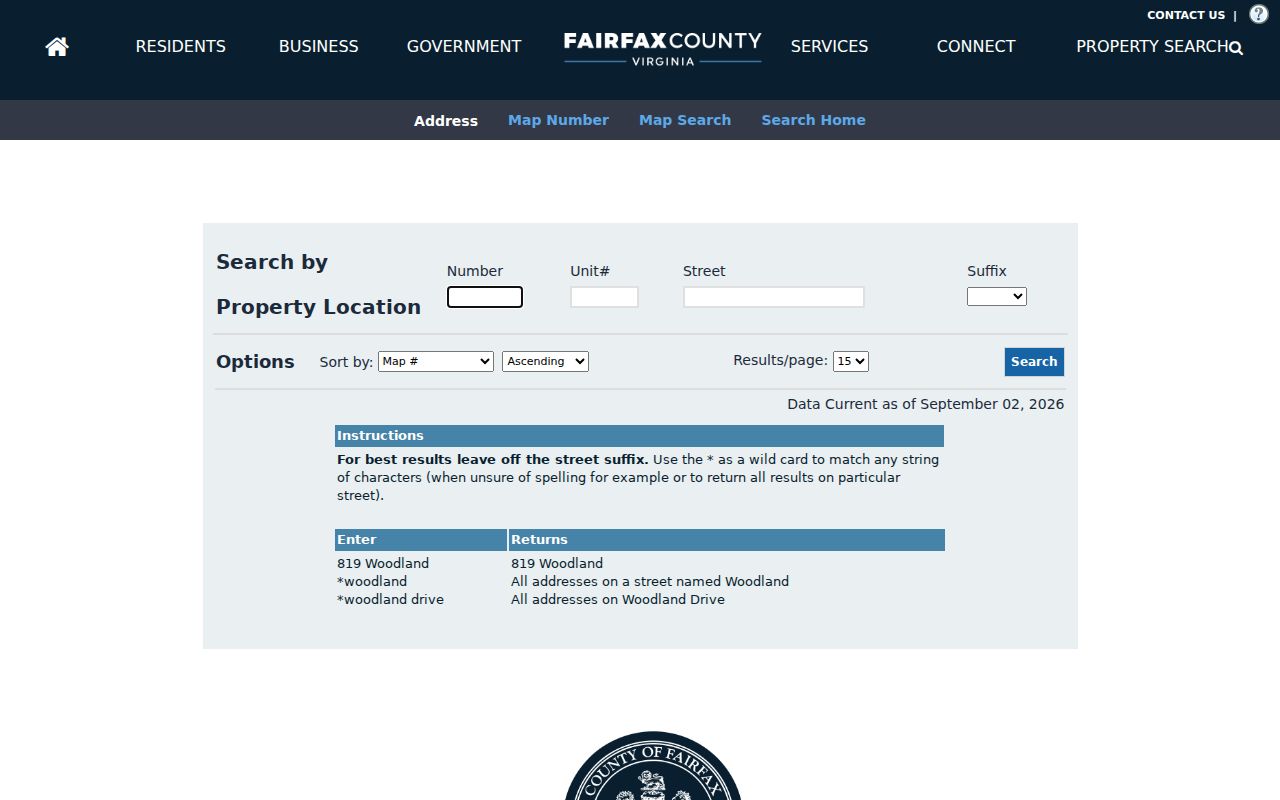
The visible controls cover number, unit, street, suffix, and sort. They make an address search reproducible on iCare, but they do not turn the assessment site into a resident roll.
Current Chantilly Residents Directory Sources
Current sources answer different questions. The best public combination pairs a county address record with an assessment card. Add a recorded instrument when the facts demand one. The voter portal serves one person at a time. It reports an individual's own status and polling place. It is not a public name-to-address directory. Court and professional records serve narrow ends. So go to the custodian that actually holds the record.
| Chantilly source | Narrow fact | Custodian | Access route |
|---|---|---|---|
| iCare parcel card | Assessment fields, owner where displayed, mailing and property location | Fairfax DTA | Free public web search |
| MAR and Jade | Address status, parcel relation, map context | Fairfax GIS | Free county tools |
| Land-record index | Recorded parties, instrument references, legal descriptions | Fairfax Circuit Court | Research terminal or CPAN |
| eCaseSearch | Nonconfidential case-index information | Fairfax Circuit Court | Free web index |
| Virginia Citizen Portal | Individual registration status or polling place | Virginia Elections | Individual self-service portal |
A parcel card can display property and mailing information. It certifies no title, no household members, no current resident. The county's sample parcel report shows how assessment fields organize themselves around the parcel rather than the people in it.
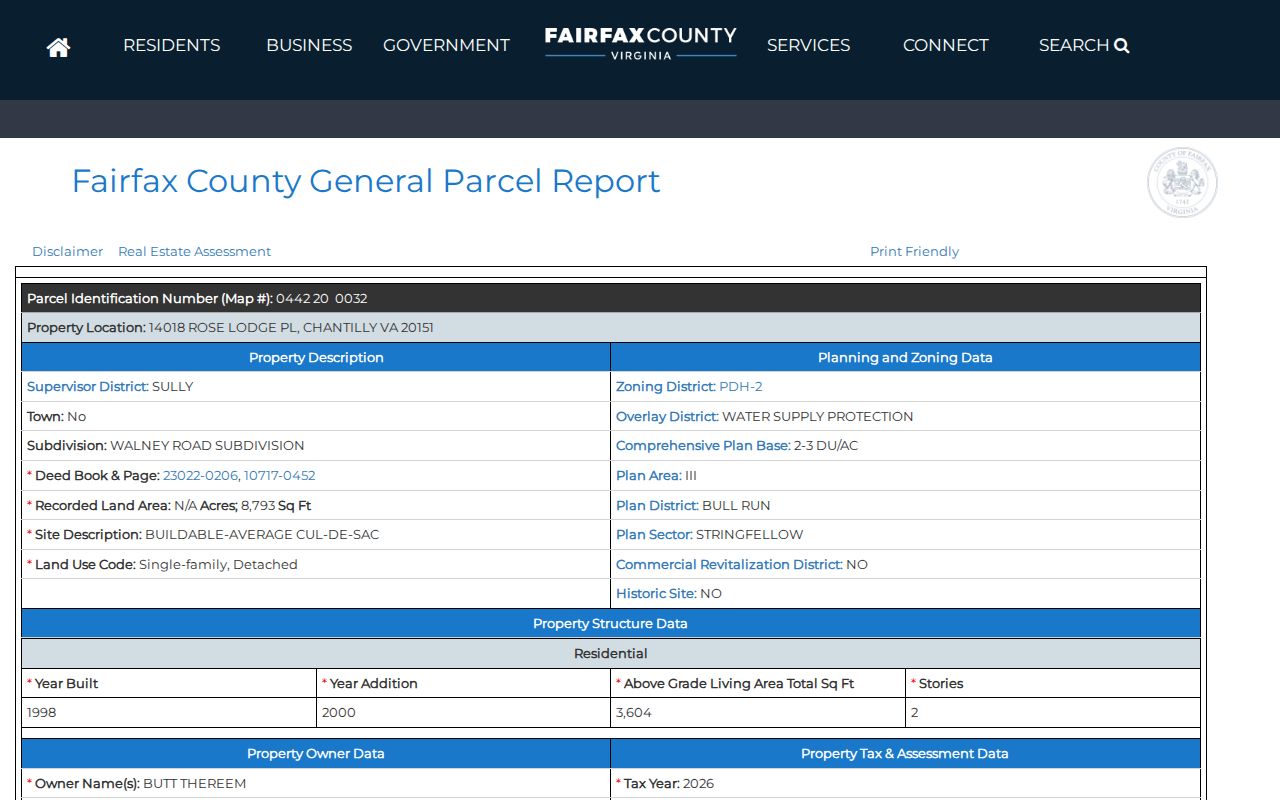
Matching fields can still mean different things. Keep the property location, parcel, owner as shown, and mailing address as separate notes even when one card lists them identically. The parcel is not the person.
Note: An owner can ask Fairfax DTA to withhold the owner's name from the Internet record, so a missing name settles nothing.
Fairfax Court Index for Name Checks
Fairfax Circuit Court eCaseSearch is a free public index. It reaches nonconfidential civil and criminal case information back to October 18, 2004, and caps each search at 100 results. Documents do not come through it. Sealed or excluded cases stay invisible. Choose civil or criminal material first, then search by party name, since a match may be a plaintiff, defendant, business, attorney, or another role.
| Visible field | Observed rule |
|---|---|
| Case Type | Civil or Criminal must be selected. |
| Search By | Party Name or Case Number. |
| Case Number | Required when that route is selected; the form shows CL, FE, and MI examples. |
| Last Name/Company Name | Required for party search, with at least two letters. |
| First Name | Optional narrowing field. |
Treat eCaseSearch as a finder. The Clerk's file-review and copy channels supply the documents and any older material.
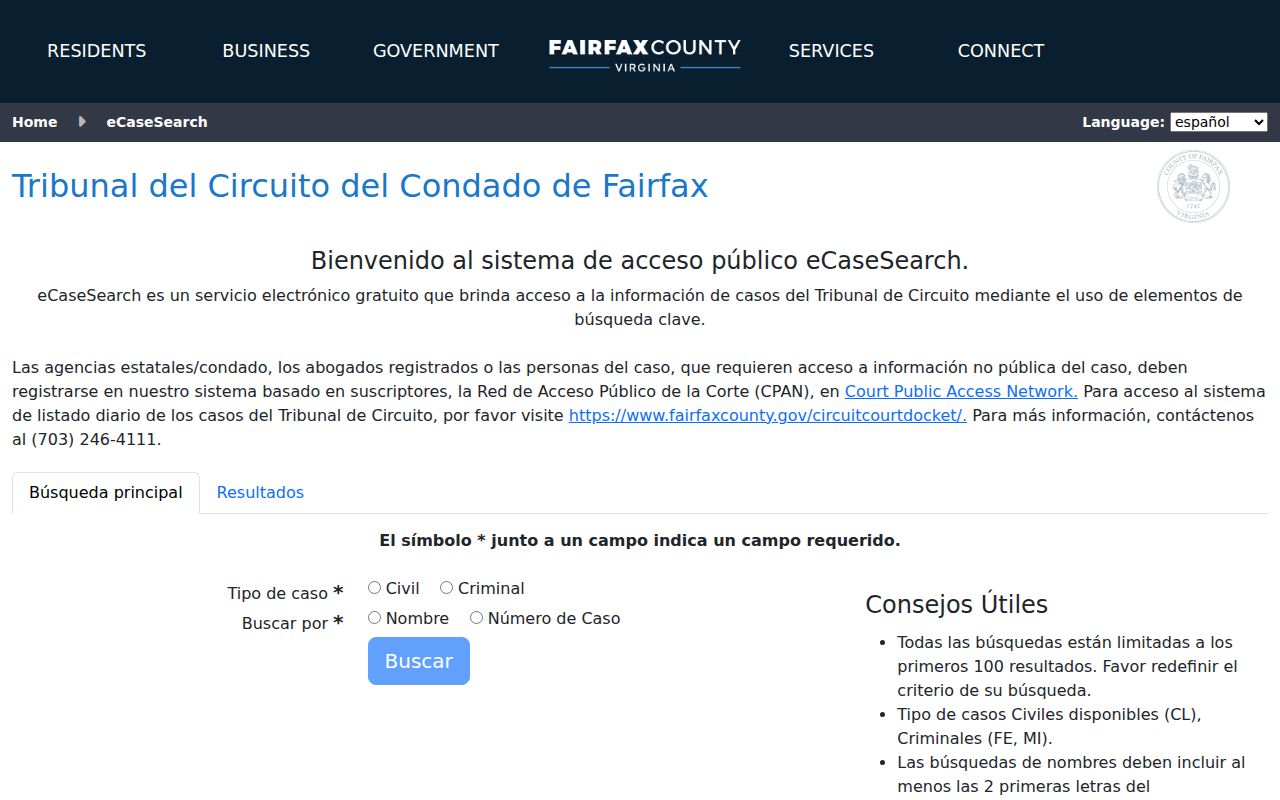
The case-type and name controls on the court's index exist to narrow a search, not to tell a story. A same-name hit is only a lead until a second record confirms the match.
Virginia Voter Tools Have Limits
The Virginia Citizen Portal handles personal civic tasks. Registration, status, polling place, and absentee requests all live there. It is not a public people directory. Virginia Code §§24.2-405 through 24.2-407 restrict who may receive voter lists. They also bar publishing a searchable voter roll online. That keeps any Chantilly residents directory built on official voter data off the table.
A historical Fairfax street file can tie a street range to a ZIP code. It can also tie that range to a precinct. But it is a 2015 snapshot, not a current voter roll. For your own civic information, the portal is the right route. For an address question, My Neighborhood adds precinct context. It adds public-facility context too, without claiming anyone lives there. Date every result, because boundaries, precincts, and portal details shift. The Citizen Portal landing page is where these individual tools start.
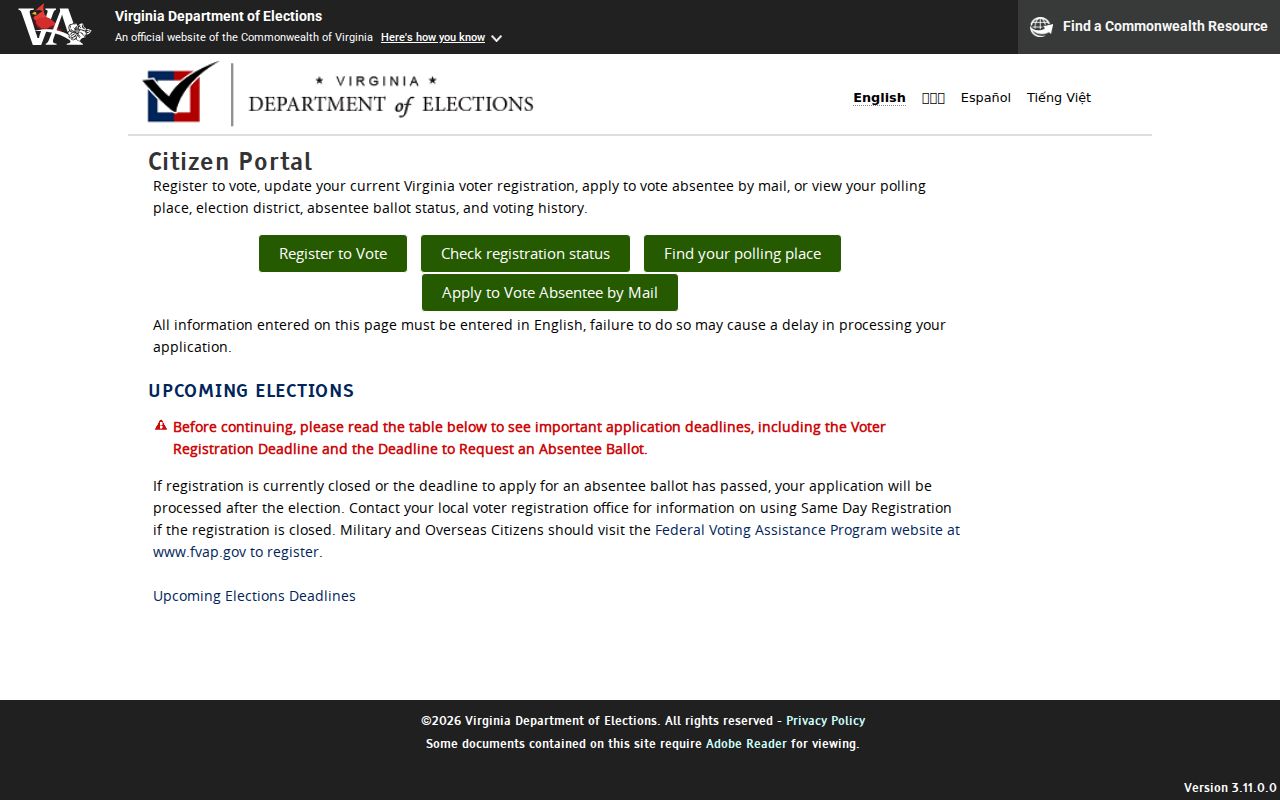
The portal's task list serves personal registration and polling-place needs. It was never meant for copying voter information into a public Chantilly residents directory.
Chantilly Postal Labels Need Context
USPS material lists CHANTILLY, VA for 20151, 20152, and 20153. Those labels are postal designations, nothing more. They do not draw a legal boundary around the Chantilly CDP. Nor do they cover every nearby Fairfax community. The Census relies on ZIP Code Tabulation Areas. Those approximate rather than copy USPS delivery boundaries. County parcel and address tools answer a different question again.
Check an address's postal ZIP with the USPS city and state lookup. Use MAR to filter county address rows by ZIP, street, parcel, subdivision, status, or dates. Never make a ZIP code directory label do the work of an address or parcel record. Context matters most when a Chantilly mailing label sits outside the Census place boundary.
Personal research only. Public records can support family, property, civic, or historical questions, but never stalking, harassment, intimidation, or unwanted contact.
Historical Chantilly Residents Directory Shelf
Chantilly's historical directory trail runs through Fairfax libraries. The Virginia Room holds community, telephone, departmental, street, and neighborhood directories. Newspapers, yearbooks, maps, manuscripts, and microform sit alongside them. The Fairfax Community Directory names Chantilly in runs from 1980 through 2005-06. Later telephone-style series and the 1980 Greenbriar Telephone Directory add narrower, dated leads. A volume-by-volume guide lives on the Chantilly city directory page.
Older shelves hold Chataigne's Virginia Gazetteer and Classified Business Directory. Its runs span several years from 1877 through 1897. Hill's Virginia Gazetteer and Business Directory covers 1906 and 1911. The Fairfax County, Virginia Directory for 1906 adds a countywide snapshot. These volumes often use post-office, farm, business, or rural-location clues. A modern subdivision address rarely appears in them.
| Collection | Recorded span | What it can supply |
|---|---|---|
| Fairfax Community Directory | 1980 through 2005-06 in listed annual or biennial runs | Community, address, household, or organization leads after the volume is inspected. |
| Your Community Phone Book | 2006-07 through 2009-10 | Later telephone-directory clues; Chantilly inclusion should be checked in the volume. |
| ZipLocal Fairfax | 2010-11 through 2016-17 in listed years | Later phone-book style listings, not an official resident roll. |
| Early gazetteers and 1906 directory | 1877 through 1911 among listed titles | County and post-office era references. |
Note: A directory entry is a dated lead tied to one source, not proof of ownership, a complete household, or a current address.
Fairfax Deeds Carry the Address Trail
The Fairfax Circuit Court's land-record path reaches from 1742 to the present. A present parcel can lead to an owner. Then it can lead to the grantor and grantee index, an instrument or deed book reference, and a legal description. Land records are digitally converted from books and microfilm. Free public terminals are available, while CPAN is the deeper subscriber route. The Historic Records Center holds original Liber deed books from 1742 through 1942.
Start with the Land Records Research Room for the custodian's instructions. A copy request can be made by instrument number or book and page. Mail requires a written request or form, payment, and a stamped return envelope. A certified copy costs $2 plus $0.50 per page. Mail requests carry a response expectation of two weeks.
The county land-record research page distinguishes public research access from the indexed record itself.
Older deeds often skip the current street number. Follow the legal description and any "same property" wording when the document leans on acreage, roads, streams, or farm names instead.
Older Chantilly Records Have Gaps
Fairfax County formed in 1742. Its courthouse geography moved from the Tysons area to Alexandria. Then it reached the current Fairfax site in 1800. Civil War losses destroyed original wills, deeds, and loose papers. Many deed books from 1763 through 1819 and numerous minute books are missing too. A clean-looking online result cannot prove a complete historical record trail.
When the web index ends, turn to the Historic Records Center. The Virginia Room and Library of Virginia microfilm are also key stops. The Library of Virginia lists Fairfax court books, marriage registers, births and deaths. Its catalog also covers roads, military material, and other county records. Note the missing range. Then look sideways to land-tax books, maps, probate, or newspapers. A surviving neighboring instrument can help too. Avoid inventing a link in the chain.
Official Sources Beat Merged Listings
A current parcel card, a recorded deed, a court index, a library directory, and a voter-status tool may share a name or address. Each answers a different question. Official sources name their custodian, jurisdiction, access rule, and update context. Commercial people-finders do not. That category can merge old addresses with unmatched names from unknown sources. It never substitutes for an original county or state record.
| Official record route | Strength | Necessary check |
|---|---|---|
| iCare and MAR | County address and assessment orientation | Separate owner, mailing, situs, and parcel fields. |
| Circuit Court record | Recorded instrument or case access through the custodian | Confirm the document, date, parties, and case status. |
| Virginia Room volume | Dated historical listing with a traceable edition | Inspect the actual page and its geographic scope. |
Virginia sets hard boundaries through its Address Confidentiality Program, restricted voter files, protected DMV information, and vital-record rules. The Virginia Freedom of Information Act, Va. Code §2.2-3704, can help with a specific county-agency record. It is not a shortcut around court, voter, vital, or confidentiality rules.
Chantilly Maps Change the Record Search
Mapping tools answer a different question than a residents directory does. Fairfax Jade GIS layers more than 170 datasets onto one viewer, with property reports, measurements, exports, and aerial imagery both current and historic. The county also publishes official Digital Map Viewer books spanning 444 tiles. Imagery reaches back to 1937, which helps explain why a road, parcel, or building looks different today. It cannot tell you who lived there.
A map is evidence, not an occupant list. Parcel lines and photographs gain real value only beside a dated deed, an assessment record, or a directory volume from the same era. For a Chantilly street address, the county's GIS and map hub collects the current mapping tools in one place, and it pairs well with a Chantilly residents directory search when you are tracing past residents of a property.