
Sources for Chantilly Previous Residents
The backward trail behind a Chantilly address changes with the era. Current assessment data is a starting point, while land records carry a deed chain and library collections add household and map context. None of these sources proves every past occupant. Use the source that fits the period, record its date, and keep the parcel history separate from the household evidence.
| Source | Years It Covers | Where Held | What It Shows |
|---|---|---|---|
| Fairfax iCare assessment records | Current assessment database | Fairfax County Department of Tax Administration | Parcel, displayed owner and mailing data, sales, assessment, and map number |
| Circuit Court land records | 1742 to present | Land Records research room, public terminals, or CPAN | Recorded instruments, indexed parties, legal descriptions, and book or instrument references |
| Historic Liber deed books | 1742 through 1942 | Fairfax Historic Records Center | Original historic deed books and related research route |
| Fairfax Community Directory | 1980 through 2005-06 | Fairfax County Public Library Virginia Room | Dated community and household clues; inspect the exact volume |
| Reverse and criss-cross directories | 1957 through 2018, depending on title | Virginia Room, neighboring local history, or interlibrary loan | Historical listed subscribers or occupants by address |
| Sanborn fire-insurance maps | Approximately 1885 through the 1960s | Library of Congress, Library of Virginia, or University of Virginia collections | Building footprint and use history, not resident identity |
For a recent question, begin with the parcel and work into the recorded conveyances. For a rural or pre-address question, begin with the legal description, acreage, adjoining owners, road, stream, farm name, or post-office clue. The first result is a lead, not a reason to combine owners, occupants, and subscribers into one label.
Note: A Chantilly mailing label, parcel identifier, situs address, and an owner mailing address should be recorded as distinct fields.
Chantilly Parcel Starting Point
Begin a Chantilly house history with the current parcel rather than a name. Fairfax iCare offers address, tax-map, and map-search paths. Copy the address exactly as displayed, retain the map number, and distinguish the property location from the owner’s mailing address. iCare assesses as of January 1 and the county says the site is refreshed twice weekly. That makes it an orientation tool, not a title decision or an occupancy list.
The Fairfax property-history bibliography links the parcel stage to deeds, maps, tax books, census schedules, and newspaper research.
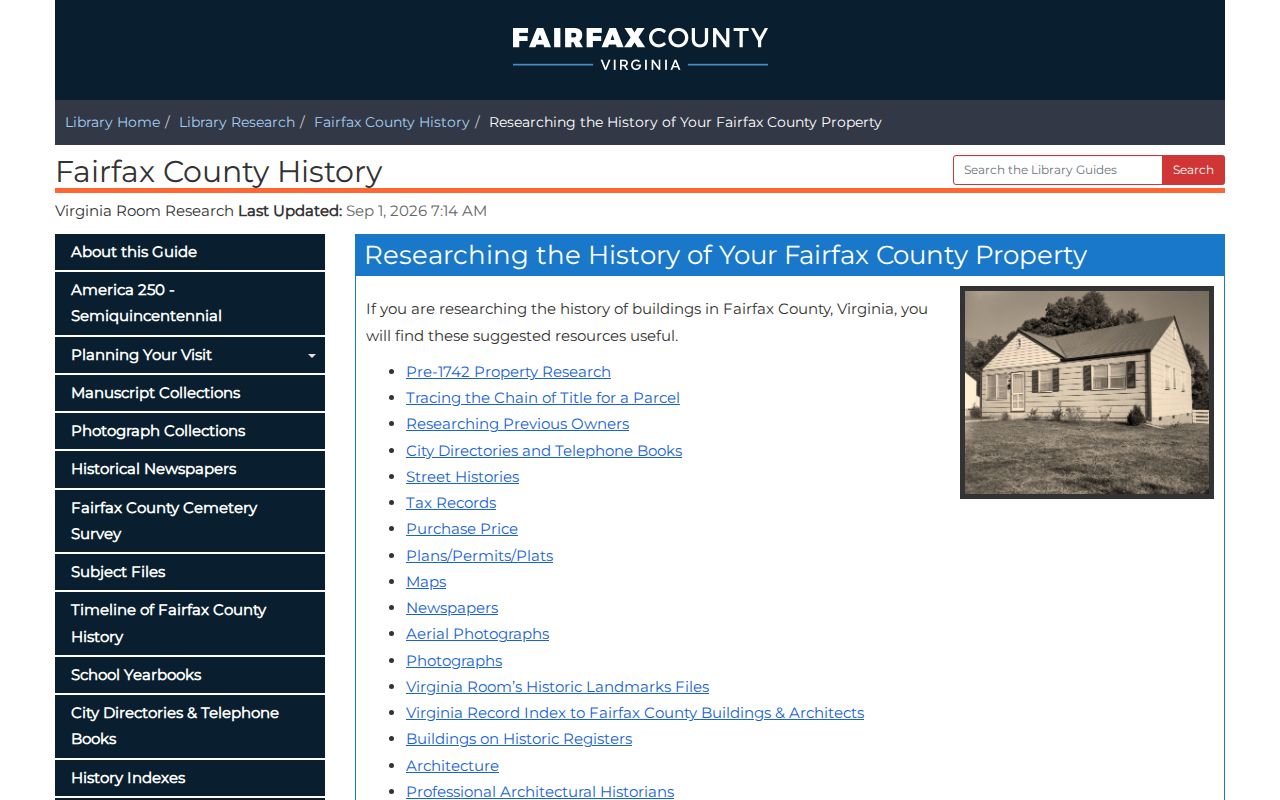
Use the parcel number as a bridge across records that spell the same street differently. If a street result is uncertain, iCare permits broader address work, including a suffix-free query and wildcard guidance, before the trail moves to land records.
Tracing Past Chantilly Residents
Past residents are often found by first tracing past owners, but the two roles must not be conflated. Fairfax land records are public and digitally converted from microfilm and books. Search the current owner as a grantee in the Fairfax County Circuit Court Land Records Division index, locate the most recent purchase, and follow the preceding grantor as the next likely grantee. Each link should preserve spelling variants, companies, trusts, and estate names where they appear.
- Copy the current parcel or map number, the exact address, and the displayed owner spelling from iCare.
- Find the current owner as grantee and capture the recording date, instrument or book-page reference, indexed parties, document type, and legal description.
- Open the instrument image when access permits. An index is a finding aid and may omit the prior-deed reference or full property description.
- Search the prior grantor as a likely earlier grantee, then compare acreage, lot, subdivision, roads, streams, and adjoining owners.
- Record a branch at an estate, partition, foreclosure, release, merger, or missing-book event instead of forcing a single chain.
- Grantor and grantee
- The grantor transfers an interest in an instrument; the grantee receives that recorded interest.
- Chain of title
- A sequence of recorded conveyances for the same property, checked link by link rather than assumed from a name.
- Legal description
- The recorded property description, such as a lot, acreage, or boundary language, that can remain useful when street numbering changes.
No populated Chantilly deed entry was captured in the research material. The fields above are the expected official index inventory, not a fabricated sample deed.
Chantilly Deed Trail at Land Records
The Fairfax Historic Records Center holds the original historic Liber deed books for 1742 through 1942, while the county describes land records from 1742 to the present as digitally converted. Its real-estate tax books cover 1851 through 1980. The center and the Land Records research room are both at 4110 Chain Bridge Road, Suite 317, and staff can explain mechanics without performing the investigation for a requester.
For deeper online access, CPAN is a paid subscription service, while the courthouse public terminals are free. When a document is needed by mail, Fairfax requires an instrument number or deed book and page, a written request or form, payment, and a stamped return envelope. The research page gives a two-week response expectation for those requests.
Note: A deed records a conveyance between named parties on a date; it does not, by itself, establish who occupied the property afterward.
Chantilly's Past Address Forms
Some Chantilly past-resident questions begin before a modern street number existed. Fairfax’s historical-property guidance tells researchers to follow the legal description, acreage, adjoining owners, roads, and streams, then layer people sources on top. A parcel may be split, combined, renamed, or absorbed into a subdivision while a household changes or moves. The phrase “same parcel” in a deed can provide the needed bridge even where a street address disappears from the trail.
Historic county publications may use a farm, route, post office, or rural locality rather than a subdivision number. The contrast between a Route 50 corridor location and a modern subdivision street illustrates why an address should not be normalized too soon. Keep the source wording, add a separate normalized parcel field, and test the continuity with deeds and maps.
For current address-keyed work after the historical trail is complete, the Chantilly street directory follows the different question of records along a named street.
Chantilly Directories for Past Households
Deeds establish the property trail. Directories and census schedules provide the household layer. The Fairfax Community Directory explicitly includes Chantilly from 1980 through 2005-06, while telephone and reverse-directory titles have their own geographic limits. A criss-cross listing can start with an address, but it is a dated subscriber or occupant clue, not a complete household or ownership record. The collections themselves are described in the Chantilly city directory holdings.
- Select the closest directory title and year for the address or name.
- Record the edition, page, exact printed line, and any abbreviation key that can be seen.
- Compare the next available volume without assuming that a disappearance means a move or death.
- Pair the directory year with the relevant census schedule and the dated deed link for the same property.
- Use a newspaper, yearbook, church record, cemetery source, or oral history to test a same-name connection.
A historical directory can place a printed listing in time. It cannot replace a source that names every person who lived at the address.
Chantilly Map Clues for Past Residents
Maps help answer the property question before they answer the people question. Fairfax’s historical-site research route pairs deeds with G.M. Hopkins 1879 and Stephenson maps where coverage applies, then adds land-tax books, maps, Sanborn material, newspapers, census schedules, and photographs. Sanborn fire-insurance maps can show a building footprint or use from approximately 1885 through the 1960s, but they do not identify an occupant.
The Fairfax historic-site research guidelines set out this locally specific parcel-to-map approach.
Match a map feature to the legal description and deed dates before attaching it to a household. A changed road or a new subdivision can explain why two sources use different address language.
The Library of Congress Sanborn search guide is the documented route for the map layer.
Use the map as a physical-history clue, then return to the directory and deed dates before identifying a past household.
Chantilly Cemetery Trail Endpoints
When the property trail and directory trail both end, Fairfax archival collections can provide family-history context. The Virginia Room includes local newspapers, yearbooks, cemetery inventory, property-history material, manuscripts, photographs, and oral histories. The Historical Society of Fairfax County finding aid also describes an 1873 Chantilly Episcopal subscription list, yearbooks, newsletters, and a 1950s historic-house tour. These are leads, not modern resident lists, and a name still needs confirmation across sources.
The Fairfax cemetery survey began with a 1977 headstone-transcription gift covering 100 cemeteries and now records more than 350 individual cemeteries. Its parcel, nearest-address, condition, and transcription context can help a family-history search, but the project should not be used to infer the occupant of a nearby property.
Lawful use. Chantilly house-history research is for family history, estate questions, and personal curiosity. Do not use a past-address trail to harass, stalk, or track a living person.
Chantilly Deed-Book Gaps
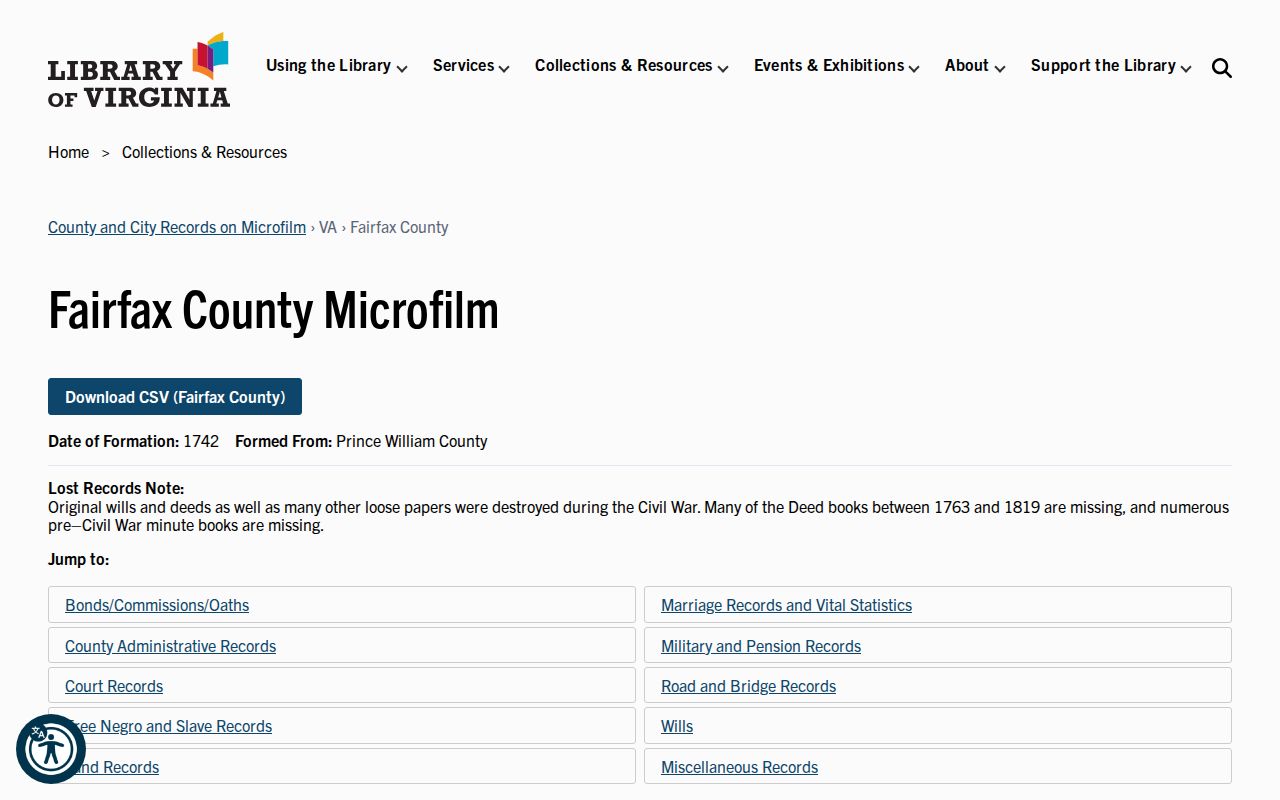
Fairfax County formed in 1742, with courthouse locations in the Tysons area from 1742 to 1752, Alexandria from 1752 to 1800, and Fairfax after that. Civil War loss destroyed original wills, deeds, and loose papers. Many deed books from 1763 through 1819 and numerous pre-Civil War minute books are missing. A break in the deed chain can therefore reflect the survival of the records rather than a break in the property’s history.
The Library of Virginia Fairfax County records guide identifies microfilmed county material and an interlibrary-loan route for older records. Mark the missing range, then branch to tax books, maps, probate, newspapers, or a surviving neighboring instrument. “Not located in surviving or indexed material” is a meaningful result.
Keeping that uncertainty visible protects the distinction between a documented past resident, a past owner, and a record that simply did not survive.