
Finding Chantilly Resident Records
There is no independent Chantilly clerk, assessor, municipal court, or voter office. Fairfax County and Virginia keep the records that may help identify an address, a recorded owner, a historical household, or a court party. Start with the fact already known. An address is best checked through the county address and assessment systems. A name needs a second identifier, such as a locality, a former address, or a case number. A dated library listing can help with family history, but it does not prove a current household.
Keep roles separate as you search. A parcel owner may receive mail elsewhere. A deed grantee is a party to a recorded transfer. A directory subscriber is a dated listing. None of those labels automatically means resident. That distinction matters in Chantilly, where postal city, Census geography, parcel location, and mailing address can use different labels.
- Check the county address and parcel record, preserving the exact address, unit if known, parcel identifier, and search date.
- Use the assessment result to distinguish the property location from the owner and mailing fields that appear.
- Match a recorded transfer through the Circuit Court land-record path when ownership history is the question.
- For an earlier household, consult the Fairfax Community Directory and related Virginia Room holdings for the right year.
- When an agency holds a record without an online index, ask that custodian about its own request, counter, library, or archive route.
Note: An empty search result can reflect a historical address, a missing unit, a restricted record, or a jurisdiction mismatch rather than an answer about a person.
Chantilly Residents Records Desks
Fairfax County supplies the local starting points for a Chantilly residents directory search. The Department of Tax Administration orients an address to a parcel. GIS tools show address status and parcel geography. The Circuit Court keeps land instruments and the public case index. The Virginia Room supplies the local history shelf. Virginia agencies take over for vital records and individual voter status. Street-by-street work belongs on the Chantilly street directory, where the address chain is set out in detail.
Fairfax DTA Real Estate
12000 Government Center Parkway, Suite 357
Fairfax, VA 22035
703-222-8234
Circuit Court Land Records
4110 Chain Bridge Road, Suite 317
Fairfax, VA 22030
703-691-7320, press 3 then 3
Fairfax Virginia Room
10360 North Street, second floor
Fairfax, VA 22030-2514
703-293-6227, option 6
The Circuit Court also offers public research terminals and its CPAN service for deeper court and land-record work. The Virginia Department of Health, not a Chantilly office, keeps vital certificates. The Virginia Department of Elections provides an individual status and polling-place portal, while voter lists are controlled by state law.
Chantilly Starts With Fairfax Geography
Chantilly is both a Census Designated Place and a community label used in Fairfax County. It is not an incorporated Virginia city. That is why a property, court, library, or planning question usually begins with Fairfax County even when the postal address says Chantilly. The Circuit Court covers Fairfax County and the City of Fairfax, but property in Alexandria and Falls Church follows those jurisdictions instead.
Use the county’s Master Address Repository for address, parcel, and street status, then use iCare for assessment fields. MAR can search current or historical address records, but it excludes apartment unit numbers and does not contain assessment data. Its presence is evidence that an address record exists, not proof of occupancy or ownership.
- Parcel
- A county identifier for a piece of land, not a street address or a household list.
- Situs address
- The physical property location. It can differ from the owner’s mailing address.
- Index
- A finding tool that points to a record; it is not automatically the document image or a certified copy.
- Criss-cross directory
- A historical directory arranged from address to listed subscriber rather than from name to address.
Search Chantilly Addresses in iCare
Fairfax iCare is the county assessment entry point. Its public interface offers address, map-number, and map-search routes. A broad address search can be more useful than forcing a suffix, because the county’s own tip says to leave the suffix off for best results. Use a wildcard only as a discovery tool, then retain the county’s spelling in the research notes. iCare is updated twice weekly, while real-estate assessments are made as of January 1.
| iCare control | How it is used | Practical limit |
|---|---|---|
| Number | Enter a street number when known. | It is optional and can be left broad. |
| Unit# | Supply a recognized unit value. | MAR separately omits apartment units. |
| Street | Use the street name; the portal shows wildcard examples. | A result is not a complete street inventory. |
| Suffix | Choose or enter it when it improves the match. | The portal advises leaving it off for best results. |
| Sort and results/page | Control how candidates are displayed. | Record the settings and date when preserving a result. |
See the official iCare address form before running a search.
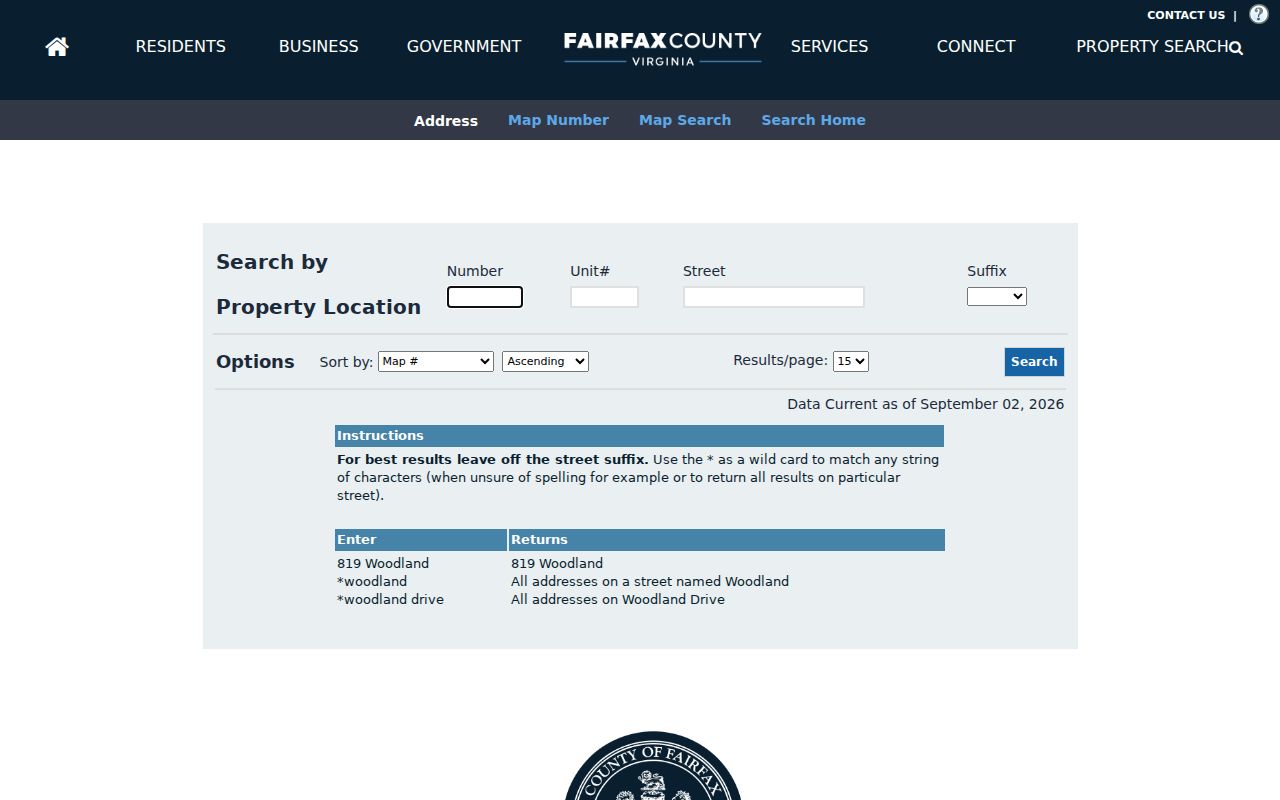
The visible number, unit, street, suffix, sort, and results controls support a reproducible address search, but they do not turn the assessment site into a resident roll.
Current Chantilly Residents Directory Sources
Current sources answer different questions and have different limits. The most useful public combination is a county address record, an assessment card, and a recorded instrument when needed. The voter portal is for an individual’s own status and polling place, not a public name-to-address directory. Court records and professional records have their own narrow purposes. Use the custodian that actually keeps the record.
| Chantilly source | Narrow fact | Custodian | Access route |
|---|---|---|---|
| iCare parcel card | Assessment fields, owner where displayed, mailing and property location | Fairfax DTA | Free public web search |
| MAR and Jade | Address status, parcel relation, map context | Fairfax GIS | Free county tools |
| Land-record index | Recorded parties, instrument references, legal descriptions | Fairfax Circuit Court | Research terminal or CPAN |
| eCaseSearch | Nonconfidential case-index information | Fairfax Circuit Court | Free web index |
| Virginia Citizen Portal | Individual registration status or polling place | Virginia Elections | Individual self-service portal |
A parcel card can display property and mailing information. It does not certify title, identify every household member, or establish a current resident. The county’s sample parcel report illustrates that assessment fields are organized around the parcel.
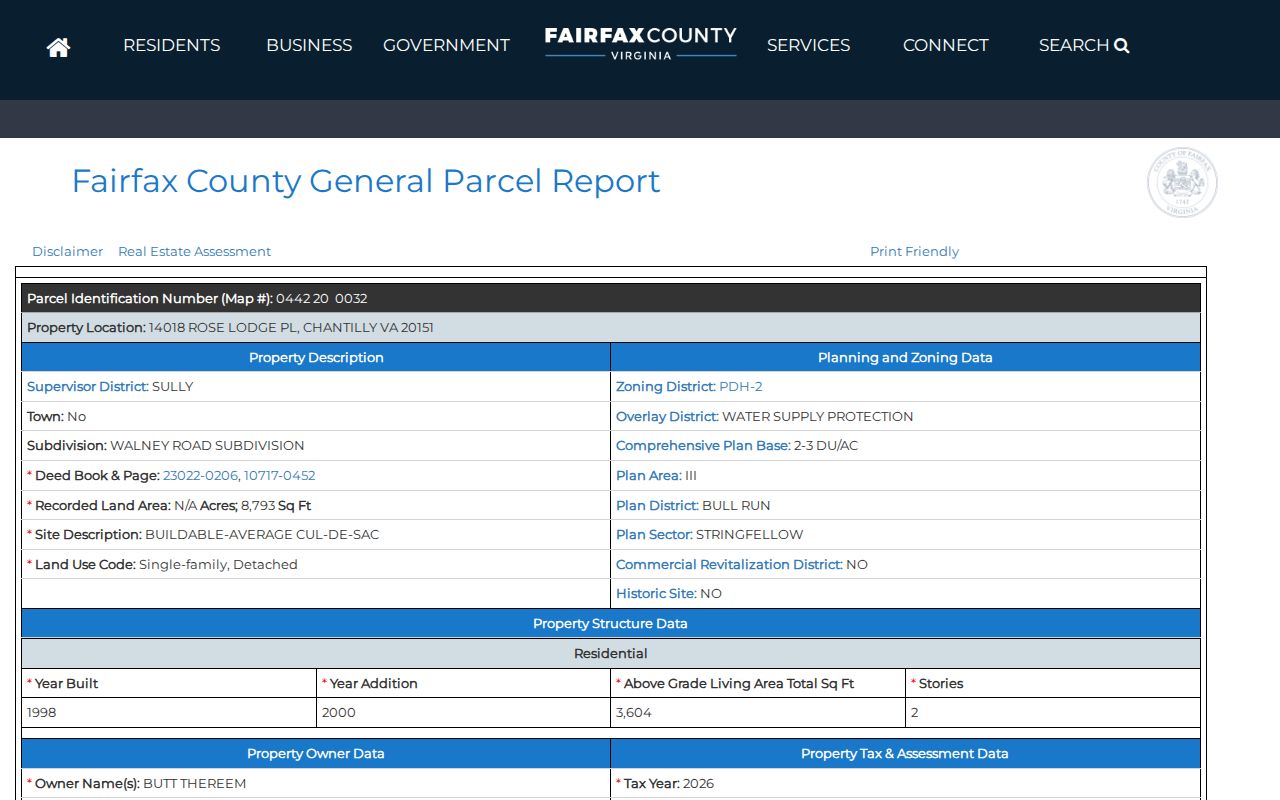
Keep the property location, parcel, owner as shown, and mailing address in separate notes, even if they happen to match on a particular card.
Note: An owner can ask Fairfax DTA to withhold the owner’s name from the Internet record, so a missing name does not settle an address question.
Fairfax Court Index for Name Checks
Fairfax Circuit Court eCaseSearch is a free public index for nonconfidential civil and criminal case information. It begins October 18, 2004 and limits a search to 100 results. It does not supply documents, and sealed or otherwise excluded cases do not appear. Search by party name only after choosing civil or criminal material; a party match may be a plaintiff, defendant, business, attorney, or another role.
| Visible field | Observed rule |
|---|---|
| Case Type | Civil or Criminal must be selected. |
| Search By | Party Name or Case Number. |
| Case Number | Required when that route is selected; the form shows CL, FE, and MI examples. |
| Last Name/Company Name | Required for party search, with at least two letters. |
| First Name | Optional narrowing field. |
Use the public eCaseSearch form as a finder, then use the Clerk’s file-review or copy channel for documents and older material.
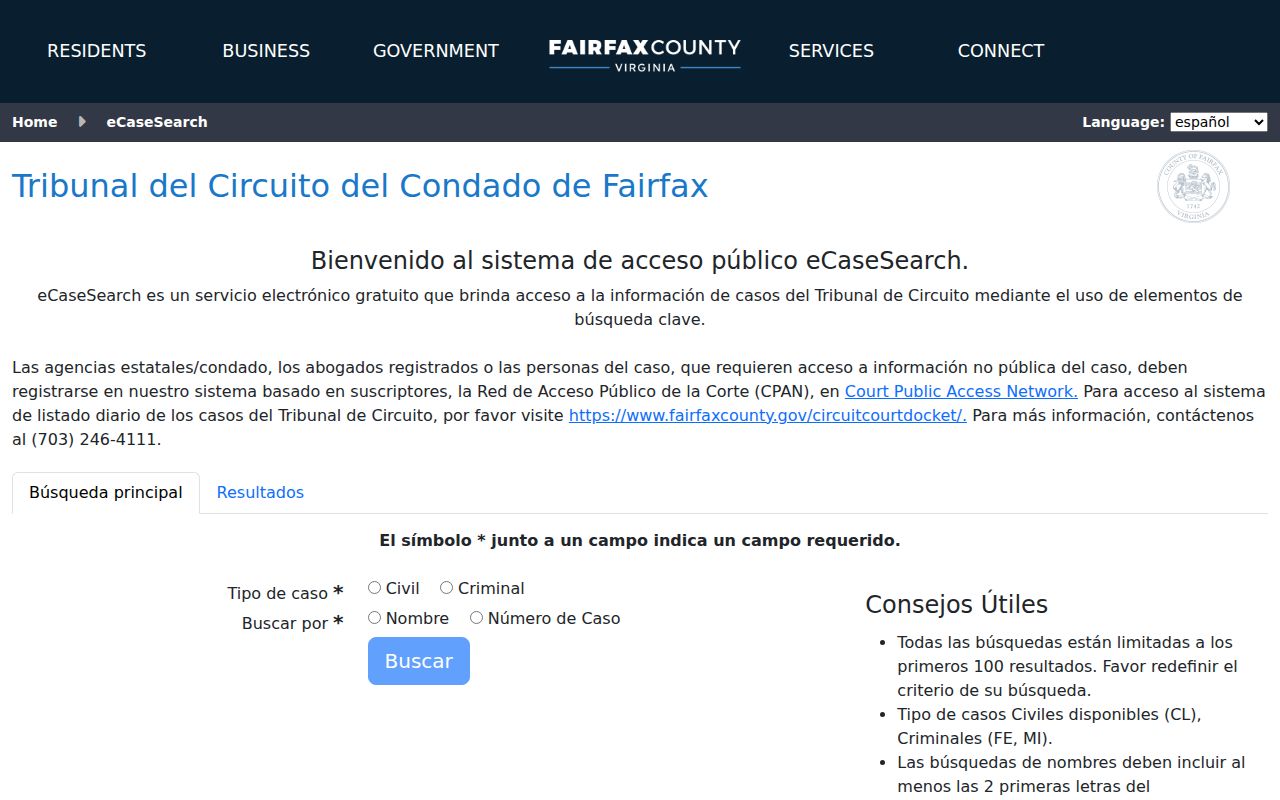
The form’s case-type and name controls show why a same-name result needs a second record and should never be treated as a narrative about a person.
Virginia Voter Tools Have Limits
The Virginia Citizen Portal offers registration, individual status, polling-place, and absentee tasks. It is not a public people directory. Virginia Code §§24.2-405 through 24.2-407 restrict voter-list distribution and prohibit publishing a searchable voter list on the Internet. A historical Fairfax street file can relate a street range to a ZIP and precinct, but it is a 2015 snapshot, not a current voter roll.
The official portal is the right route for a person checking their own civic information. For an address question, My Neighborhood can provide precinct and public-facility context without claiming that someone lives there. Date every result because boundaries, precincts, and portal details can change.
The Citizen Portal landing page is the current starting point for these individual tools.
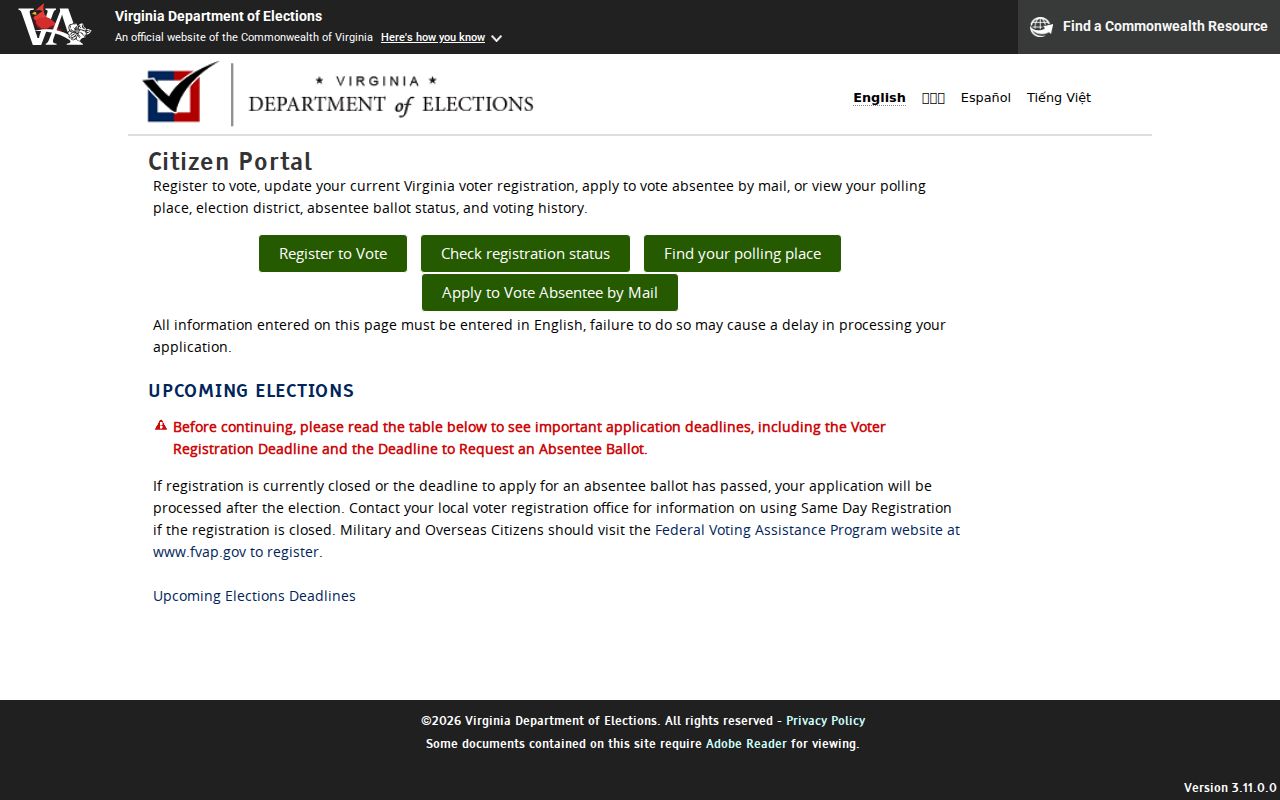
The portal’s task choices support personal registration and polling-place use, not copying voter information into a public Chantilly residents directory.
Chantilly Postal Labels Need Context
USPS postal material lists CHANTILLY, VA for 20151, 20152, and 20153. Those are postal designations, not a legal boundary for the Chantilly CDP or every nearby Fairfax community. The Census uses ZIP Code Tabulation Areas for statistics, and its ZCTAs approximate rather than duplicate USPS delivery boundaries. County parcel and address tools answer a different question again.
Use the USPS city and state lookup to check an address’s postal ZIP. Use MAR to filter county address rows by ZIP, street, parcel, subdivision, status, or dates. Do not make a ZIP label do the work of an address or parcel record. This local geography is especially important when a Chantilly mailing label appears outside the Census place boundary.
Personal research only. Public records can support family, property, civic, or historical questions, but never stalking, harassment, intimidation, or unwanted contact.
Historical Chantilly Residents Directory Shelf
Chantilly’s historical directory trail is a Fairfax library trail. The Virginia Room holds community, telephone, departmental, street, and neighborhood directories, along with newspapers, yearbooks, maps, manuscripts, and microform. The Fairfax Community Directory explicitly includes Chantilly in runs from 1980 through 2005-06. Later telephone-style series and the 1980 Greenbriar Telephone Directory add narrower, dated leads. A full volume-by-volume guide is available through the Chantilly city directory page.
Earlier holdings include Chataigne’s Virginia Gazetteer and Classified Business Directory in several years from 1877 through 1897, Hill’s Virginia Gazetteer and Business Directory for 1906 and 1911, and the Fairfax County, Virginia Directory for 1906. These publications may use post-office, farm, business, or rural-location clues instead of a modern subdivision address.
| Collection | Recorded span | What it can supply |
|---|---|---|
| Fairfax Community Directory | 1980 through 2005-06 in listed annual or biennial runs | Community, address, household, or organization leads after the volume is inspected. |
| Your Community Phone Book | 2006-07 through 2009-10 | Later telephone-directory clues; Chantilly inclusion should be checked in the volume. |
| ZipLocal Fairfax | 2010-11 through 2016-17 in listed years | Later phone-book style listings, not an official resident roll. |
| Early gazetteers and 1906 directory | 1877 through 1911 among listed titles | County and post-office era references. |
Note: A directory entry is a dated source-specific lead, not proof of ownership, a complete household, or a current address.
Fairfax Deeds Carry the Address Trail
The Fairfax Circuit Court’s land-record path reaches from 1742 to the present. A present parcel can lead to an owner as shown, then to the grantor and grantee index, an instrument or deed book reference, and a legal description. Land records are digitally converted from books and microfilm; free public terminals are available, while CPAN is the deeper subscriber route. The Historic Records Center holds original Liber deed books from 1742 through 1942.
Use the Land Records Research Room first for the custodian’s instructions. A copy request can be made by instrument number or book and page, with a written request or form, payment, and a stamped return envelope for mail. The research notes list a certified copy at $2 plus $0.50 per page and a response expectation of two weeks for mail requests.
The county land-record research page distinguishes public research access from the indexed record itself.
Follow the legal description and any “same property” wording when an older deed uses acreage, roads, streams, or farm names instead of the current street number.
Older Chantilly Records Have Gaps
Fairfax County formed in 1742. Its courthouse geography moved from the Tysons area to Alexandria and then to the current Fairfax site in 1800. Civil War losses destroyed original wills, deeds, and loose papers, and many deed books from 1763 through 1819 as well as numerous minute books are missing. A clean-looking online result therefore cannot prove a complete historical record trail.
When the web index ends, move to the Historic Records Center, Virginia Room, and Library of Virginia microfilm. The Library of Virginia lists Fairfax court books, marriage registers, births and deaths, roads, military material, and other county records. Note the missing range and look sideways to land-tax books, maps, probate, newspapers, or a surviving neighboring instrument instead of inventing a link in the chain.
Official Sources Beat Merged Listings
A current parcel card, recorded deed, court index, library directory, and voter-status tool may share a name or address while answering different questions. Official sources identify the custodian, jurisdiction, access rule, and update context. A commercial people-finder category can combine old addresses and unmatched names from unknown sources, so it is not a substitute for an original county or state record.
| Official record route | Strength | Necessary check |
|---|---|---|
| iCare and MAR | County address and assessment orientation | Separate owner, mailing, situs, and parcel fields. |
| Circuit Court record | Recorded instrument or case access through the custodian | Confirm the document, date, parties, and case status. |
| Virginia Room volume | Dated historical listing with a traceable edition | Inspect the actual page and its geographic scope. |
Virginia’s Address Confidentiality Program, restricted voter files, protected DMV information, and vital-record rules set hard boundaries. The Virginia Freedom of Information Act, Va. Code §2.2-3704, can help with a specific county-agency record, but it is not a shortcut around court, voter, vital, or confidentiality rules.
Chantilly Maps Change the Record Search
Fairfax Jade GIS supplies more than 170 layers, property reports, measurements, exports, current and historic aerial imagery, and map tools. The county also provides official Digital Map Viewer books across 444 tiles. Historic imagery reaches back to 1937, which can help explain a road, parcel, or building change. It cannot establish who lived in a structure.
Map evidence is most useful beside a dated deed, assessment record, or directory volume, because parcel boundaries and imagery are not an occupant list. The county’s GIS and map hub links the current mapping tools used to orient a Chantilly address.