
Chantilly City Directory Holdings
Chantilly did not operate as an incorporated city with its own city-directory publisher. The useful shelf is the Fairfax County collection, where the Fairfax Community Directory explicitly includes Chantilly among several Fairfax-area communities. A directory entry is a dated lead, not proof that everyone at an address lived there or that a recorded owner occupied the parcel. Start with the run closest to the question, preserve the volume title, and keep the community label exactly as printed.
| Collection | Years | Where Held | Access |
|---|---|---|---|
| Fairfax Community Directory | 1980 through 2005-06 | Fairfax County Public Library Virginia Room | Reference and rare-collection holdings; inspect the volume |
| Your Community Phone Book | 2006-07 through 2009-10 | Virginia Room reference collection | Check each volume for Chantilly coverage |
| ZipLocal Fairfax | 2010-11, 2011-12, 2013-14, 2014-15, and 2016-17 | Virginia Room reference collection | Historical phone-book style resource |
| Greenbriar Telephone Directory | 1980 | Virginia Room, VRARE 917.5529 G 1980 | Neighborhood-level Chantilly-area lead |
The gaps matter. The later phone-book titles do not establish a current resident list, and their geographic scope can differ from the Chantilly CDP or a postal label. The Fairfax directory holdings page is the best starting catalog because it identifies the title and collection before a researcher relies on a listing.
Note: Keep a missing year in the research log rather than treating a gap between directory volumes as evidence that a household left.
Chantilly Directories at Virginia Room
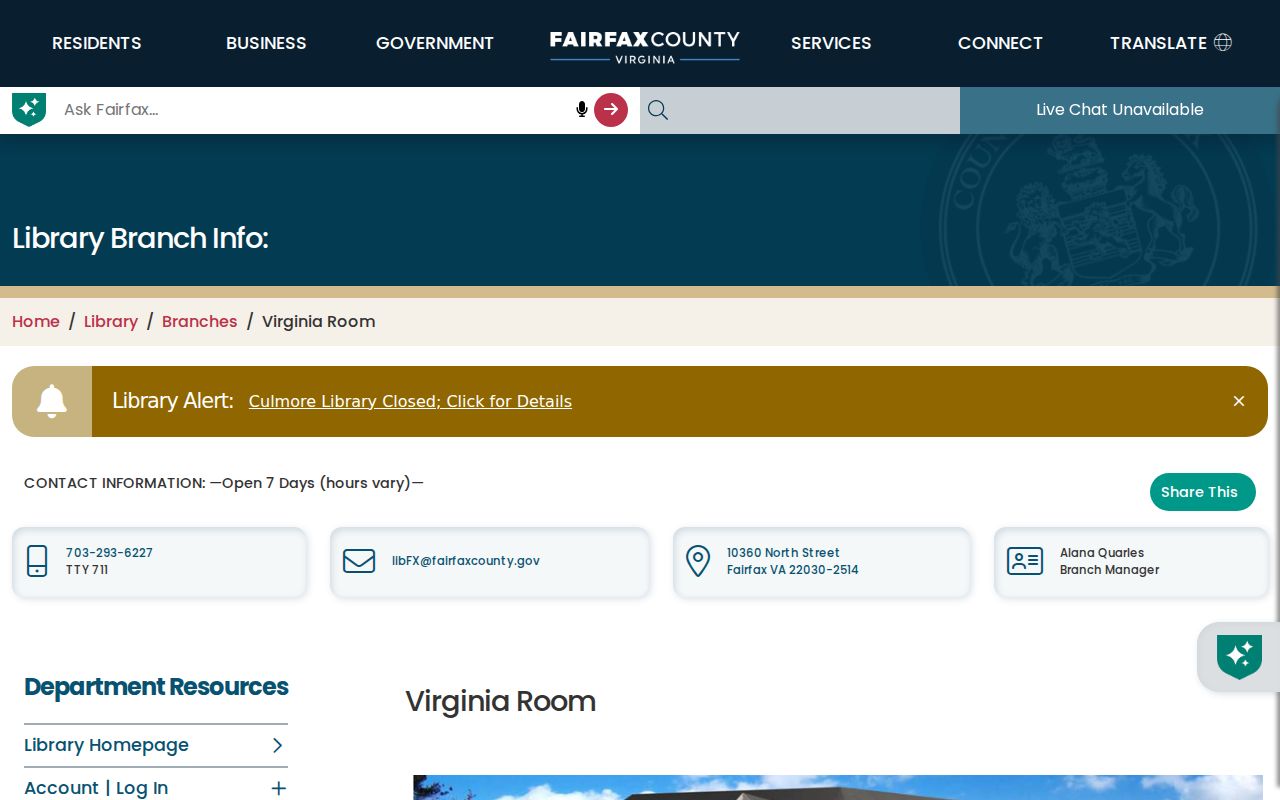
The Fairfax County Public Library Virginia Room is the local shelf for historical Chantilly directory work. It is on the second floor of City of Fairfax Library and combines directories and telephone books with maps, local newspapers, yearbooks, manuscripts, photographs, oral histories, cemetery material, and a property-history guide. Its microform reader-printer supports USB saving, so a useful directory find can be saved with its title page and page reference. Library staff can help identify titles, years, call numbers, and local-history leads.
The Virginia Room collection page shows the local-history access point used for Chantilly directory research.
Use the room’s directories beside its maps and newspaper resources. A volume can supply a date and address, while another source can test whether the same name belongs to the same person.
Hours vary, with the regional schedule listed as Monday through Wednesday from 10 to 9 and Thursday through Sunday from 10 to 6. The room can be reached at 703-293-6227, option 6. It is a research access point, not a substitute for a custodian-certified land record.
Before Chantilly Community Directories
Older Chantilly directory research needs a wider Fairfax and Virginia frame. The Virginia Room lists Chataigne’s Virginia Gazetteer and Classified Business Directory for 1877, 1880, 1884, 1888, 1890, and 1897; Hill’s Virginia Gazetteer and Business Directory for 1906 and 1911; P.P. Mast & Co.’s 1878 farmer and post-office list; and the Fairfax County, Virginia Directory for 1906. These are not modern address books. A post-office, farm, or business description may be the only place clue for a rural predecessor.
- Set a year range before selecting a Chantilly directory or gazetteer.
- For the early period, compare the county title, post-office wording, and any printed locality description.
- Open the official 1906 directory index only as a scanned source, then cite the image or page actually read.
- Move from the dated listing to a deed, map, tax book, or census schedule when the address is not yet modern.
A 1906 scan was located, but its line structure was not machine-verified during the research run. That is why a plausible surname or a search-result label should never be expanded into an invented entry.
Reading Chantilly Directory Evidence
There is no verified sample line from the scanned 1906 directory, the 1953 temporary dial directory, or the Fairfax Community Directory in the research material. A Chantilly volume should therefore be read from the actual image or shelf copy, not from a generic claim about directory fields. Capture the edition and page before interpreting any line. Transcribe only what the page makes visible, including a spelling or abbreviation that seems unusual.
| Title and edition | Record the cover or title-page wording and year before comparing a listing. |
|---|---|
| Page or image | Keep the exact page or scan image that supports the transcription. |
| Printed name and address | Copy them only when they are visible in the actual Chantilly-related volume. |
| Telephone or household notation | Capture it only if printed; it was not verified as a field in the inspected scans. |
| Legend and abbreviations | Read any key in that edition before assigning meaning to a symbol or shortened word. |
| Source note | State whether the line came from a physical volume, microform, or a specific scanned image. |
- Criss-cross directory
- A reverse directory arranged from an address toward a listed subscriber or occupant clue.
- Householder index
- An index that may identify a household head, but only where the particular volume supplies one.
- Abbreviation key
- The volume-specific legend that must be read before a shortened label is interpreted.
The 1953 temporary dial directory remains image-based at the library scan route. Its fields should be inventoried only after someone views its page image.
Chantilly Reverse Directory Paths
An address-first search uses a criss-cross or reverse directory differently from a name-first Chantilly directory. Fairfax reports that its Virginia Room does not hold the Haines Criss-Cross Northern Virginia series. A neighboring local-history collection has early-1970s to present Haines runs that include Fairfax street addresses, so interlibrary loan or a local-history visit may be necessary. Fairfax does list related Hill’s reverse directories for nearby Fairfax City, Alexandria suburban, Falls Church, and Vienna coverage.
Reverse listings can help locate a historical subscriber by street number. They do not prove ownership, full household membership, or a present address. The strongest result keeps the directory title, its stated geographic scope, the year, and the exact address alongside a separate deed or parcel source.
Note: A broad Northern Virginia title can include Fairfax streets without covering every Chantilly neighborhood or every year in the same way.
Greenbriar's Chantilly 1980 Directory
The Greenbriar Telephone Directory, Chantilly, VA, dated 1980 is a useful local clue because it links a neighborhood name with the broader Chantilly postal and community label. It does not turn Greenbriar into a synonym for all of Chantilly. Fairfax’s community-directory geography also groups Chantilly with Centreville, Fair Oaks, Kamp Washington, Kings Park, Mantua, and Merrifield. Preserve the name the volume used instead of silently changing it to fit a current boundary.
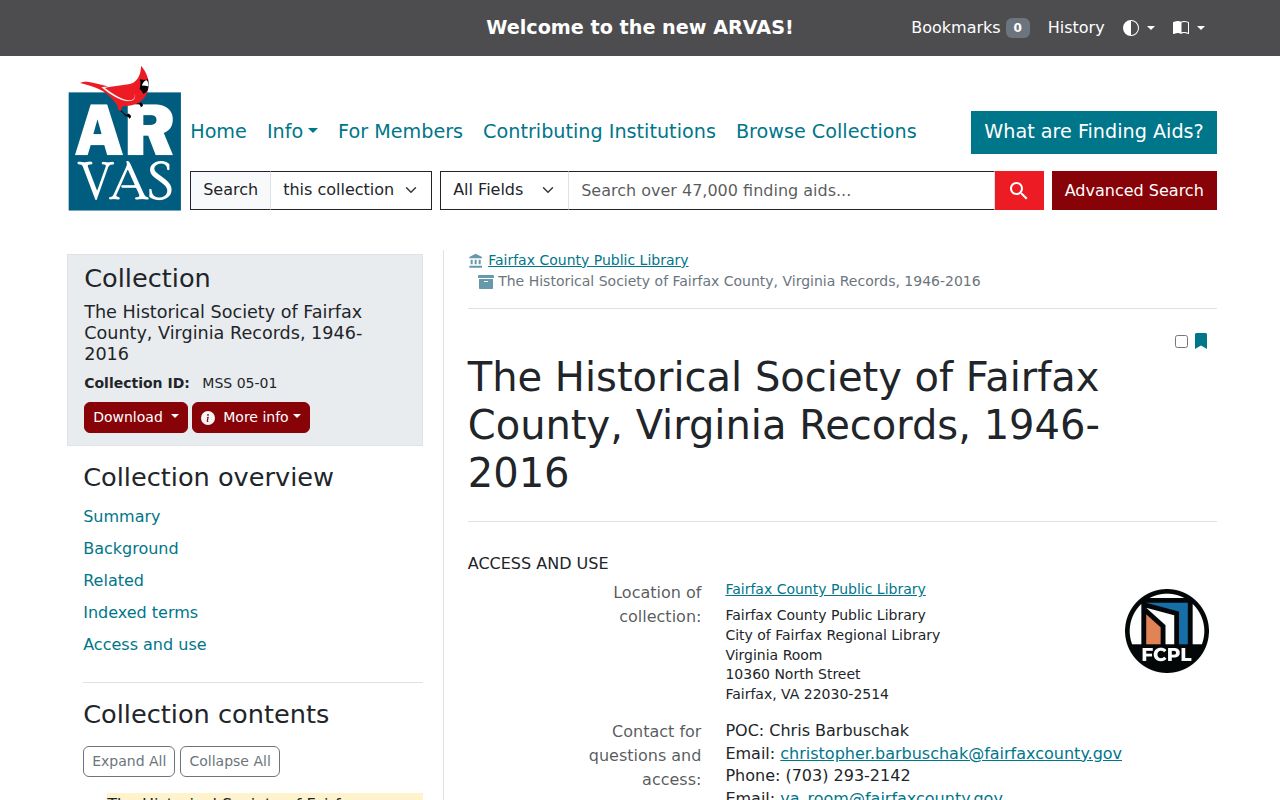
The Historical Society of Fairfax County finding aid is another companion source for a Chantilly directory trail. Its MSS 05-01 finding aid covers 1946-2016 across 192 components and describes material such as yearbooks, newsletters, a 1950s historic-house tour, and an 1873 Chantilly Episcopal subscription list. It has no online items, so it is a finding aid rather than a readable collection.
Use these collections to develop a family-history question, then verify a name or property connection in the relevant directory, deed, cemetery, or newspaper source.
Chantilly Directory Shelf by Year
The Fairfax local-history catalog places community, telephone, criss-cross, street, and neighborhood materials on the same research shelf. That makes title selection important. A Fairfax Community Directory is the strongest documented Chantilly-specific community run for 1980 through 2005-06, while a later phone book needs a volume-by-volume check. Telephone holdings also include Washington-area and Northern Virginia white-page runs, but a familiar metropolitan title is not proof of Chantilly coverage.
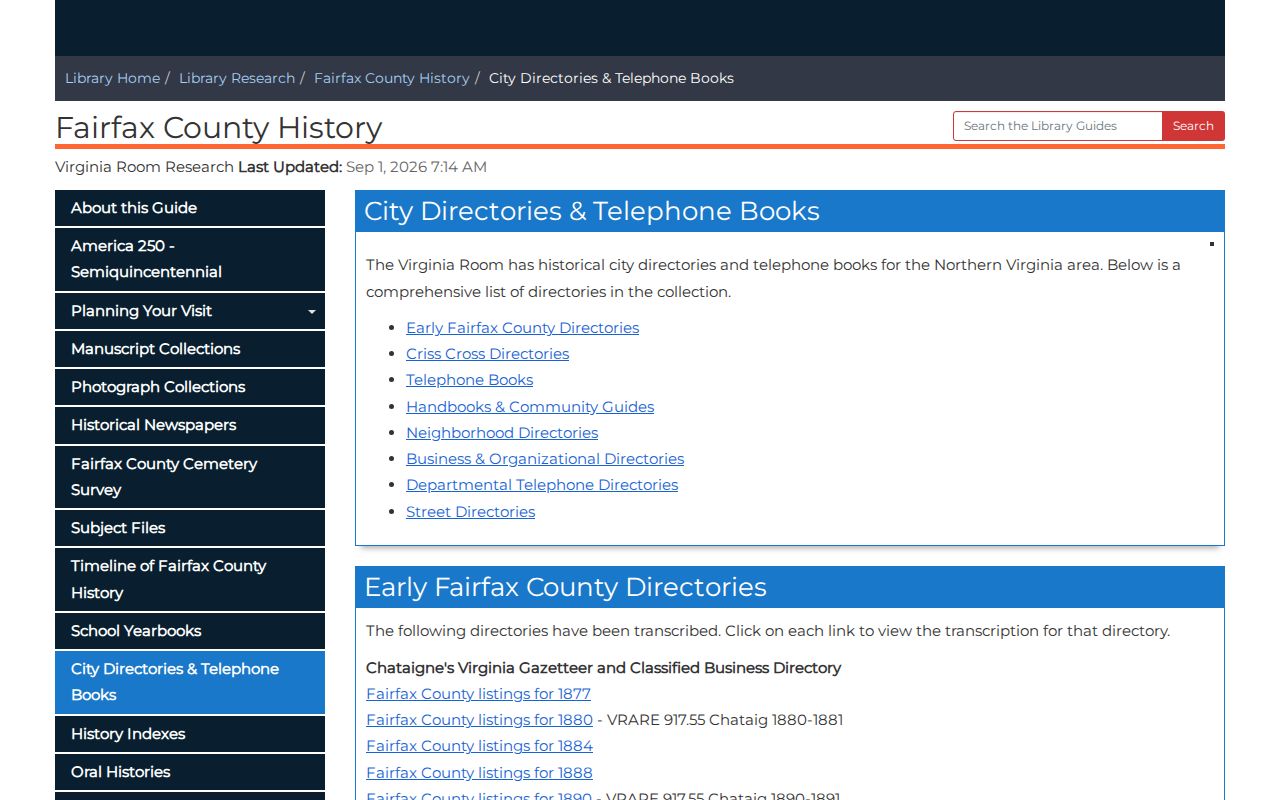
Start with the catalog title and year, then request or inspect the actual item. That step avoids treating a holdings list as if it were a searchable person index.
Tracing a Chantilly Directory Household
A household trail moves forward and backward through dated evidence. A dated Chantilly volume can establish that a printed listing existed in a particular edition. A federal census schedule can add household context for its census year, and a deed can document a recorded transaction. Those are different forms of evidence. Keep them in separate columns rather than calling each one a resident record.
- Choose the known name, address, neighborhood, or year and select the closest directory title.
- Record the edition, page, exact printed wording, and any volume-specific key that is visible.
- Check the next available directory year for a move, spelling change, or absence, without assuming why an entry changed.
- Pair the directory year with the appropriate census schedule and Fairfax land-record research for the property question.
- Use newspapers, yearbooks, cemetery material, churches, or oral histories to test a same-name match.
When the aim shifts from a historical listing to a modern identity question, use the separate Chantilly resident lookup path rather than treating an old directory line as current proof.
Chantilly Directory Gaps and Courthouses
Fairfax County was formed in 1742, and early county records followed courthouse locations in the Tysons area, Alexandria, and then Fairfax. Civil War loss destroyed original wills, deeds, and loose papers; many deed books from 1763 through 1819 and numerous pre-Civil War minute books are missing. An early Chantilly directory or property trail may therefore end in a surviving-record gap rather than in a definitive answer.
The Library of Virginia Fairfax County records guide points to microfilmed county material and an interlibrary-loan route. Mark the range searched and the material that survives. “Not located in surviving or indexed material” is more accurate than declaring that no family or owner existed.
Note: Directory coverage, courthouse survival, and a person’s presence at an address are separate questions that should remain separately documented.
Chantilly Directory Endpoints
A last appearance in a Chantilly directory can lead to a newspaper, obituary, cemetery, probate, or family-history source, but it does not identify the reason for the disappearance by itself. The Fairfax cemetery survey grew from a 1977 gift documenting 100 cemeteries to more than 350 recorded individual cemeteries. Its project records location and parcel-related context as well as transcriptions and condition information.
That scale makes the cemetery survey a useful endpoint for family history, especially when paired with the Virginia Room’s newspapers and the Historical Society finding aid. The county described future public GIS or database access as an active 2026 initiative, so the current interface should be checked before relying on a new search tool.